

A Saturday in Nisf Jubeil
Hello,
My name is Anhar. I manage content and marketing for Palbox, and I'm based in Ramallah.
I chose a Saturday to visit Nisf Jubeil.
Not because it's easier — it isn't. But because Saturdays are when settlers observe "Shabbat", which makes the roads a little safer for us to move through. So I left early, drove through several checkpoints, and made my way northwest of Nablus toward a village I had been wanting to see since we first decided to include their ceramics in the Summer Palbox.
I will be honest. I was nervous on the way.
I had heard you need to enter through Sebastya, the larger village nearby. At one point I spotted a road on the map that looked like it might cut through to Nisf Jubeil — narrow, winding, beautiful. I hesitated. Any unfamiliar road here carries a weight it shouldn't have to carry. You think about settlers moving through the same mountains. You know that a wrong turn is rarely just a wrong turn.
I arrived safely. I want to say that plainly, because it is not something to take for granted.
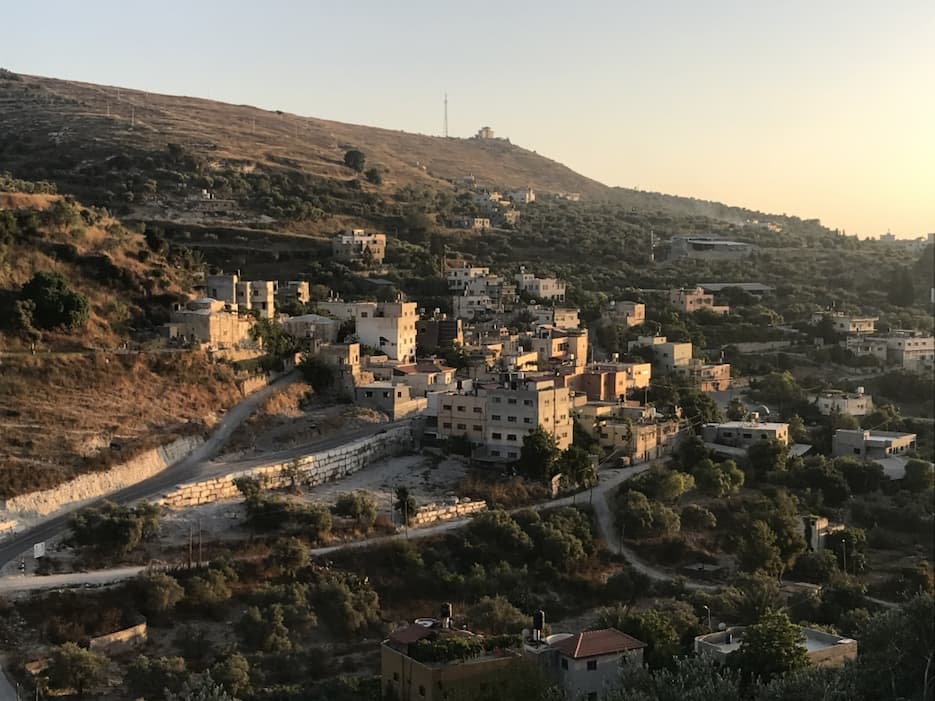
The village
Nisf Jubeil sits halfway up a hillside, interlocked by mountains on three sides. From a distance, the stone houses dissolve into the rock until the village becomes almost indistinguishable from the landscape itself.
The name carries several origins. In Greek, "jbeil" means the sun, so Nisf Jubeil once meant "half of the sun" — because the mountains delay both sunrise and sunset, leaving the village in full light for only part of the day. In Arabic, jbeil means a small mountain, and nisf means half. Either translation fits what you see.
Evidence of settlement here stretches back to the Neolithic period. Pottery sherds from the late Roman, Byzantine, early Muslim, and Medieval eras have all been found in the soil. Springs brought people first, then olive trees, then centuries of uninterrupted life on the same land.
Today the village has around 500 people. And no high school. The children walk to Sebastya — at least 20 minutes each way — because not every family can afford a private taxi. Every morning and every afternoon, the kids make that walk. It is the kind of detail that stays with you.
And yet when you arrive, you notice what the village has chosen to build with what it has: a restaurant run by its women. A ceramic mural at the entrance. A large decorative ball made entirely of ceramic, and a bank facade, tiled in ceramic. The workshop did not just give four women an income. It gave the village a new way of marking itself.
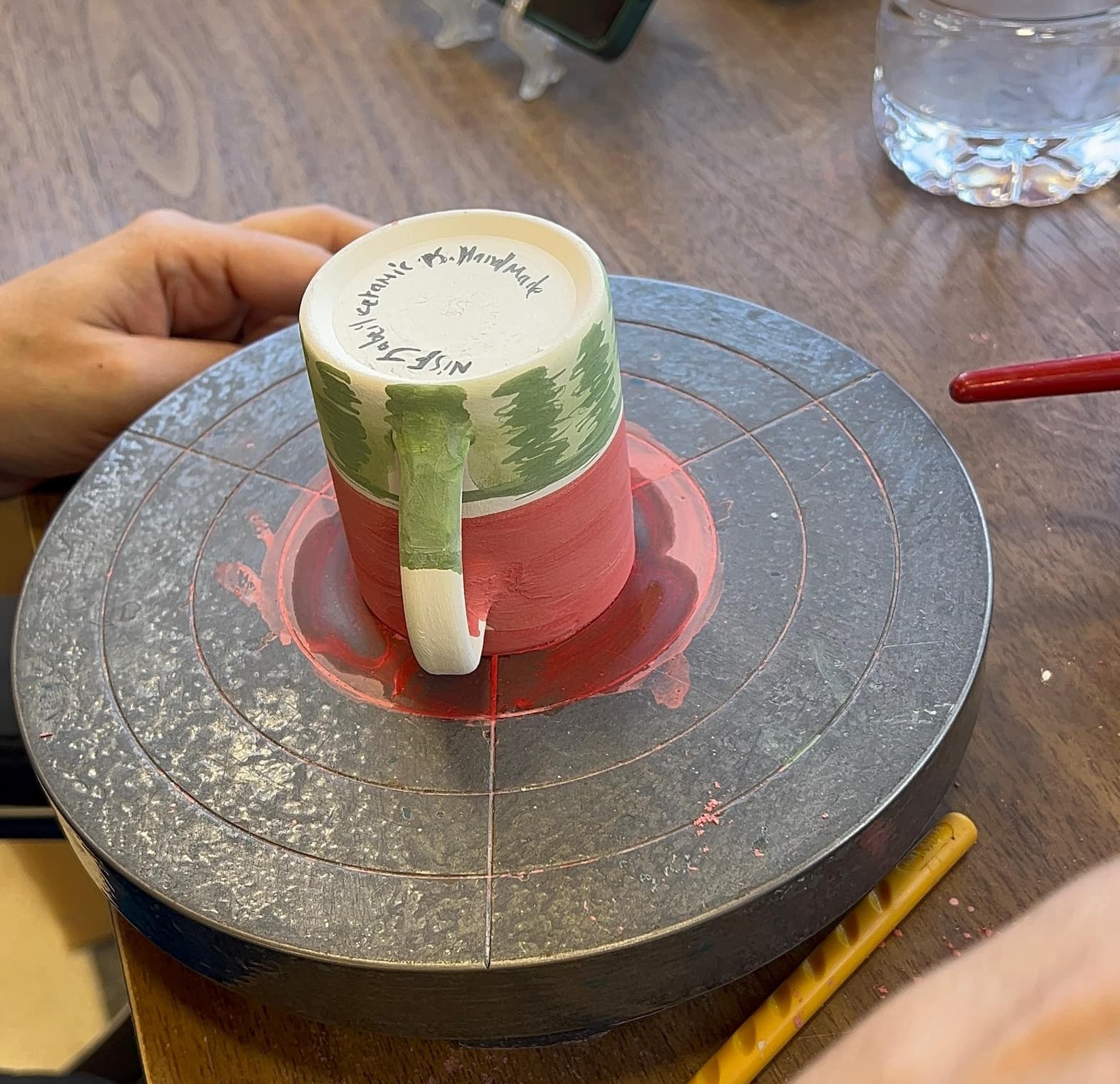
How your mug was made
In 2015, a ceramics workshop opened here — the first of its kind in the northern West Bank — with training brought in from Italy and from An-Najah National University. The first women trained. Then they trained the women who came after them. The knowledge moved hand to hand, not from a manual, not from a factory.
Today, 4 women work in this workshop. One is a widow. One is divorced. One is single. One is married. For all of them, it is their main source of income.
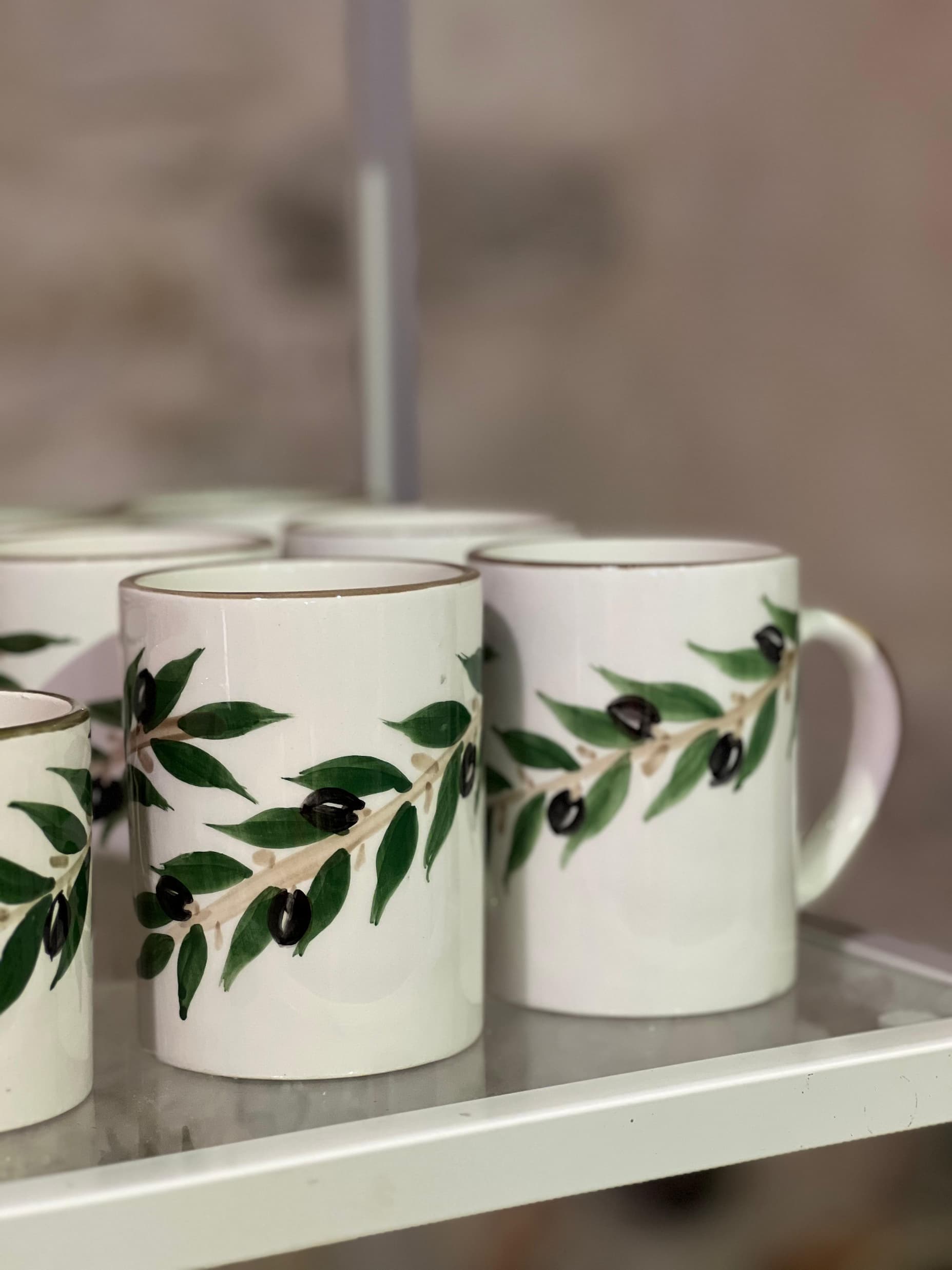
I drank coffee with them. I saw the mugs lined up before and after the kiln. I heard pieces of their stories. And I could not leave without buying things for myself — I went home with the mug you now have in your box, and a ceramic teapot I did not plan on and do not regret at all.
The ceramic pieces begin in Hebron, fired into bisque — raw, undecorated clay forms. They arrive at the Nisf Jubeil workshop pale and unfinished. The women paint them by hand. They apply a layer of glaze. Then the piece goes into the kiln and stays there for eight hours.
The next day, the women come back and lift it out.
That is the mug in your Summer Palbox.
What she asked us
Before I left, one of the women said something I have not stopped thinking about since.
"We preserve our heritage and our name through art. The people who receive our work outside Palestine — please share our story. Honestly, your voice matters. And right now, it is making a difference."
So I am telling you. And now you know.
Please share their story. 🌿
— Anhar, from the Palbox Team