

How Palestinians Carry Summer Into Winter
When Palestinians say that we save summer for winter, we mean it quite literally. The phrase may sound poetic if you did not grow up with it. But it began as something practical.
Before refrigerators, freezers, supermarkets, and year-round produce, every harvest arrived according to its own time. A fig tree did not give a family only the number of figs they could eat that week. Grapevines did not wait until the pantry was empty. Tomatoes, herbs, pomegranates, and olives ripened when the land was ready. Sometimes, they arrived in quantities too large to eat while they were still fresh.
Throwing that food away meant losing months of work, a gift from the land, and something the family might need later. So Palestinian families learned how to transform it.
They dried, boiled, pressed, pickled, cured, and concentrated what each season offered. This collection of food prepared for the months ahead is often called mouneh, from the Arabic word for provisions or pantry stores.
Figs
At the height of summer, ripe figs can be everywhere at once. Some are eaten directly from the tree. Some become jam. Others are left to dry beneath the sun. Those dried figs are called quttayn.
They are gathered, dried until much of their moisture disappears, gently flattened, and stored for the colder months. Long after the fig season ends, quttayn carries its sweetness into winter.
Grapes
Some are dried into raisins. Some are cooked into malban, a soft, dense confection traditionally made by concentrating fruit juice, most commonly grape juice, and allowing it to set. Others become dibs al-enab, or grape molasses.
To make dibs, grape juice is slowly reduced until a large harvest becomes a smaller amount of dark, intensely sweet syrup. It can then be eaten with bread and tahini, added to desserts, or used to bring depth to cooking.
Pomegranates
As summer gives way to fall, pomegranates arrive. Their juice can also be reduced into dibs al-rumman, or pomegranate molasses. This version is darker, sharper, and both sweet and sour. A spoonful can carry the brightness of pomegranate season into meals throughout the year.
Olives
Then comes the olive harvest. Families and neighbors gather beneath the trees, collecting fruit that will be cured for the table or taken to the press. The olives become oil, sometimes called Palestine's liquid gold.
A season of trees, harvesting, hands, waiting, and pressing is concentrated into a bottle that will remain at the center of the Palestinian table long after the harvest ends.
This is what it means to save summer and fall for winter. It is not simply storing food. It is capturing the soul of a season before it passes.
Knowledge as preservation
But preservation in Palestine has never been limited to what sits inside a jar. Every method carries knowledge. Someone has to know when a fig is ready to dry. How thick grape dibs should become. How long olives need to cure. Which herbs should be gathered, how they should be bundled, and when the sun is warm enough to dry them.
That knowledge was often passed through observation rather than written instructions. A child watched a grandmother's hands. A daughter learned how a mixture should look. A family remembered which tree produced the best fruit. A village developed its own names, preferences, and methods.
Today, fewer families prepare every preserve at home. Malban might be purchased instead of made in the kitchen. Herbs may come packaged rather than hanging in bundles near a window.
But the knowledge has not disappeared. It continues through the people who still farm, harvest, press, cook, document recipes, and teach the next generation what these foods are called and where they come from.
That is also cultural preservation.
Preserving Palestine means keeping the farmer's name with the olive oil. It means naming the village connected to the sumac. It means writing down a grandmother's recipe without removing the people and places that carried it. It means protecting familiar tastes from childhood, while also allowing Palestinian makers to create something new.
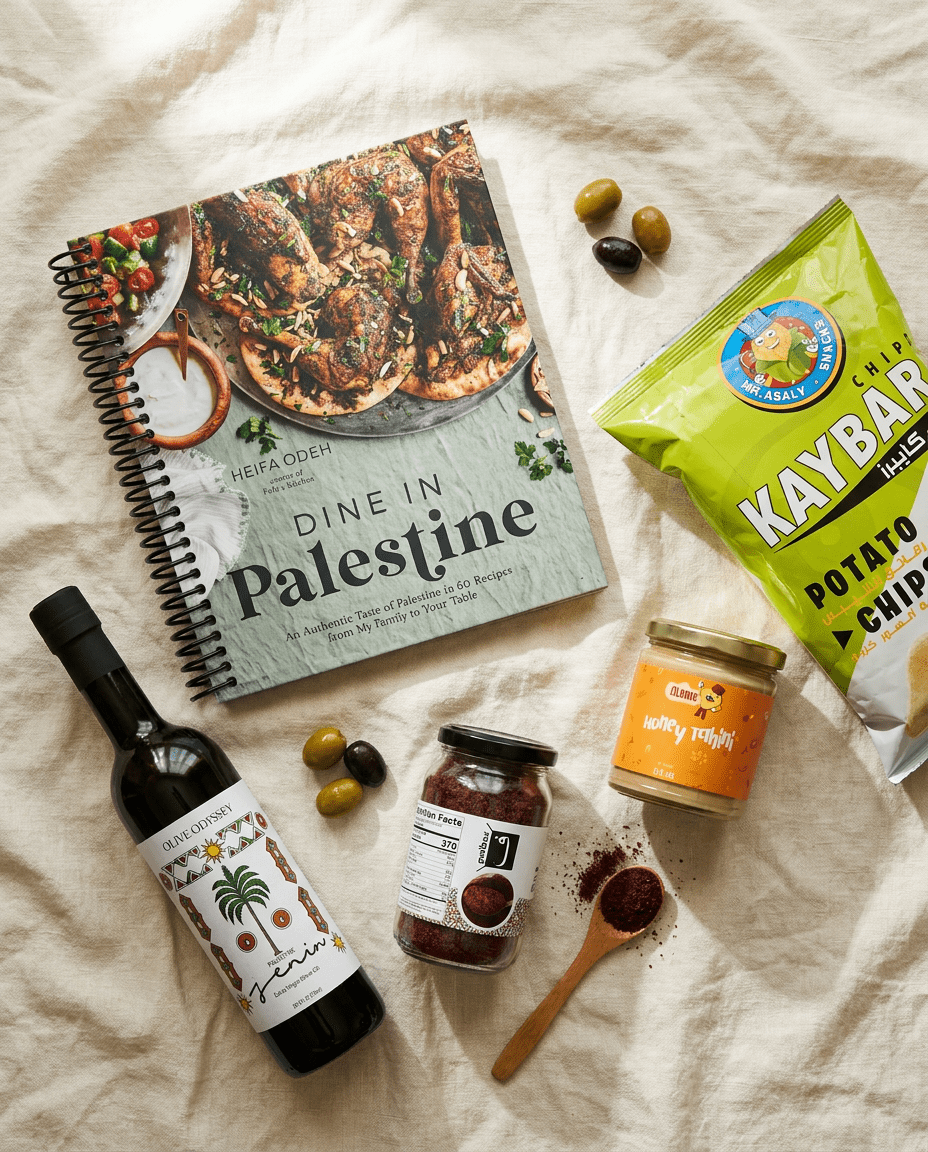
Five products. Five ways of carrying Palestine forward.
This season's Fall Palbox brings a few of these traditions together. Rumi olive oil carries the land and work of Mohammad Zein Al-Dein in Jenin. Sumac carries the knowledge of Palestinian women from Asira al-Shamaliya. Dine in Palestine preserves Heifa Odeh's recipes, family memories, and the name of Palestine on every copy. Kaybars preserves a familiar piece of Palestinian everyday life and the snacks generations grew up eating. And honey tahini shows that preservation does not mean freezing Palestinian food in the past — Palestinian flavors can continue to grow, travel, and become part of something new.